

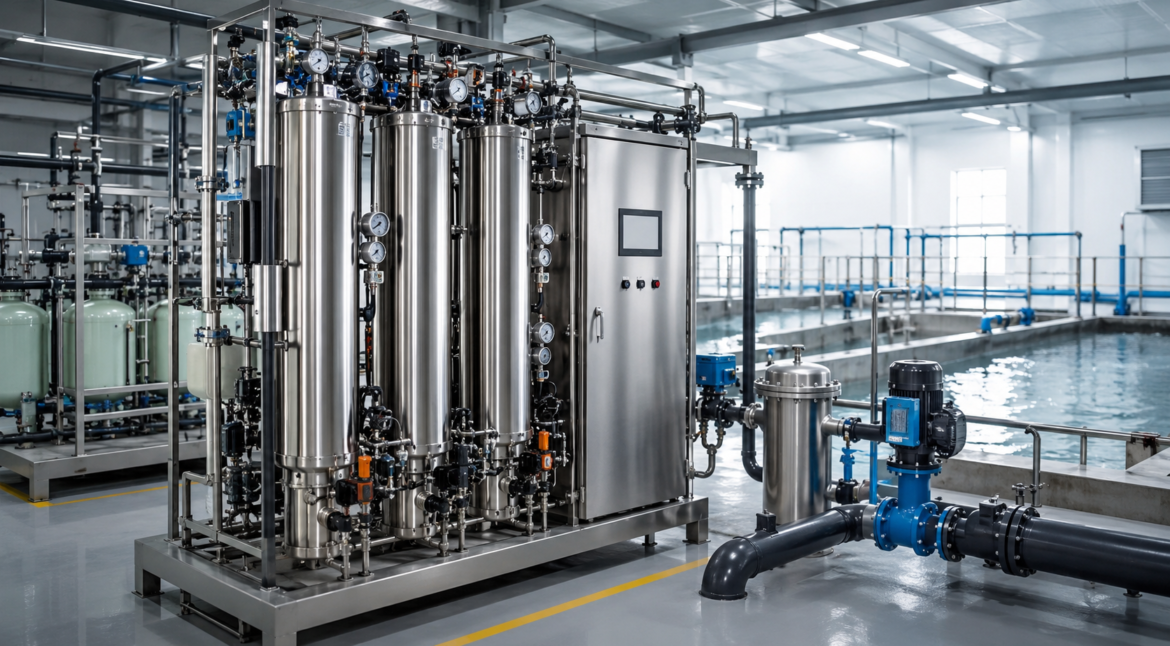
Water treatment industries need reliable technologies to improve water quality, control microorganisms, and manage oxidation requirements. Industrial ozone generators provide a powerful solution for many of these applications. Ozone contains three oxygen atoms and acts as a strong oxidizing agent. Therefore, industries use ozone technology for water treatment, wastewater treatment, process water, aquaculture, food processing, pharmaceutical applications, and more.
As an experienced industrial ozone generator manufacturer and supplier, we focus on practical solutions for different industrial water treatment requirements. Our systems can support applications that need consistent ozone production, efficient ozone transfer, and dependable operation.
What Is an Industrial Ozone Generator?
An industrial ozone generator produces ozone from oxygen-containing gas. The system generates ozone on-site and then transfers it into water through a suitable injection and mixing arrangement.
Unlike traditional chemical treatment methods, ozone generation does not require users to store large quantities of ozone. Instead, the generator creates ozone when the treatment process needs it. As a result, industries can integrate ozone generation into different water treatment systems.
The required ozone generator capacity depends on several factors. These factors include water flow, water quality, contaminant levels, ozone dosage, contact time, and the specific treatment objective.
Therefore, industries should select the generator according to actual process requirements rather than choosing equipment based only on output capacity.
How Does an Industrial Ozone Generator Work?
An industrial ozone generator follows a straightforward treatment process.
First, the system supplies oxygen or suitable feed gas to the ozone generator. Next, the generator uses an electrical discharge process to convert oxygen molecules into ozone. Then, the system transfers the generated ozone into the water.
A suitable injector, diffuser, or mixing system helps dissolve ozone into the water. After that, ozone reacts with oxidizable substances and microorganisms.
Finally, the water moves through the required treatment stages. Depending on the application, the complete system may include filtration, ozone contact tanks, monitoring equipment, and off-gas treatment.
This process allows industries to control ozone production according to their treatment needs.
Key Benefits of Industrial Ozone Generators
Industrial ozone generators offer several advantages for modern water treatment applications.
1. Strong Oxidation Performance
Ozone acts as a powerful oxidizing agent. Therefore, it can react with various organic and inorganic substances in water. This property makes ozone useful for oxidation and disinfection processes.
2. On-Site Ozone Production
An ozone generator produces ozone at the point of use. Consequently, industries can reduce their dependence on transporting and storing ozone itself.
3. Water Disinfection
Ozone can support microbial control in suitable water treatment applications. Many water treatment systems use ozone as part of a broader disinfection process.
4. Odor and Taste Control
Certain compounds can create unpleasant odors and tastes in water. Ozone oxidation can help address some of these compounds. Therefore, ozone technology can support better water quality in selected applications.
5. Flexible Industrial Applications
Ozone generators work across many industries. For example, manufacturers use ozone systems for drinking water, process water, wastewater, aquaculture, food and beverage operations, swimming pools, and other applications.
6. Easy System Integration
Manufacturers can integrate ozone generators with other water treatment technologies. For example, a treatment plant can combine ozone with filtration, RO, UV, or other suitable processes.
High-Capacity Ozone Generators for Industrial Water Treatment
Large industrial facilities often require higher ozone production because they process large water volumes. Therefore, high-capacity ozone generators can provide the required ozone output for large-scale treatment systems.
Industrial systems can range from smaller gram-per-hour units to large kilogram-per-hour installations. The correct capacity depends on the water flow and ozone demand of each project. Current industrial ozone systems on the market include configurations designed for municipal water treatment, large STP and ETP plants, and industrial processes.
However, higher capacity does not automatically mean better performance. The system must match the actual process conditions. Proper ozone dosing, gas preparation, mixing, contact time, and monitoring all influence treatment performance.
Applications of Industrial Ozone Generators
Drinking Water Treatment
Water treatment plants can use ozone as part of an oxidation and disinfection process. In addition, ozone can support the management of certain taste and odor compounds.
Industrial Wastewater Treatment
Factories often need advanced treatment solutions for wastewater. Ozone can support oxidation processes in selected industrial wastewater applications. Industries such as textiles, pharmaceuticals, food processing, chemicals, paper, and other manufacturing sectors can use ozone-based treatment systems.
Process Water Treatment
Many manufacturing facilities need treated water for production processes. Therefore, engineers can integrate ozone generators into process water treatment plants according to the required water quality.
Food and Beverage Industry
The food and beverage industry requires controlled water quality and sanitation processes. Ozone technology can support selected water treatment and sanitation applications.
Aquaculture
Aquaculture facilities need good water quality for healthy aquatic environments. Ozone systems can support water treatment and recirculation processes when engineers design the system correctly.
Pharmaceutical Applications
Pharmaceutical manufacturing requires carefully controlled water systems. Therefore, ozone technology can support specific water treatment processes where the application requires oxidation or disinfection.
How to Choose the Right Industrial Ozone Generator
Choosing the correct ozone generator requires careful evaluation. First, identify the water flow rate. Next, evaluate the raw water quality and treatment objective.
Then, determine the required ozone dosage. After that, select the appropriate ozone generator capacity and ozone injection system.
You should also evaluate the following factors:
- Ozone production capacity
- Feed gas quality
- Water flow rate
- Ozone dosage
- Water temperature
- Water chemistry
- Contact time
- Ozone transfer efficiency
- Cooling system
- Automation requirements
- Safety equipment
- Maintenance requirements
- After-sales technical support
Furthermore, a professional manufacturer can help you select the correct configuration according to your project requirements.
Why Choose a Professional Ozone Generator Manufacturer?
A reliable industrial ozone generator manufacturer and supplier does more than provide equipment. The manufacturer should understand your application and recommend an appropriate solution.
First, experienced engineers can evaluate your water treatment requirements. Next, they can recommend the suitable ozone output. Then, they can help integrate the ozone generator with your existing treatment plant.
In addition, professional suppliers can provide installation assistance, operating guidance, maintenance support, and replacement components.
Therefore, choosing an experienced supplier can help businesses build a more dependable ozone treatment system.
Maintenance of Industrial Ozone Generators
Regular maintenance helps keep an ozone generator operating efficiently. Therefore, operators should follow the manufacturer’s maintenance schedule.
First, inspect electrical connections and system components regularly. Next, check the feed gas system and cooling arrangement. Then, monitor ozone production and operating parameters.
Operators should also inspect ozone injection equipment, valves, tubing, fittings, and safety systems. In addition, they should check ozone leak detection equipment where applicable.
Proper maintenance can help identify problems early. As a result, businesses can reduce unexpected downtime and maintain consistent system performance.
Safety Considerations for Ozone Systems
Ozone provides strong oxidation performance, but operators must handle it responsibly. Ozone can irritate the respiratory system at elevated concentrations. Therefore, industrial facilities should use appropriate safety controls.
A professional ozone installation should include suitable ventilation, monitoring, leak detection, and off-gas management according to the application and applicable safety requirements.
Furthermore, trained operators should follow the manufacturer’s operating instructions. Regular inspections can also help maintain safe equipment operation.
Why Invest in High-Capacity Ozone Technology?
Modern industries increasingly focus on water reuse, efficient treatment, and responsible resource management. Therefore, many facilities are evaluating advanced oxidation and disinfection technologies.
A high-capacity ozone generator can support large-scale water treatment when the system matches the required process conditions. Moreover, engineers can combine ozone with other treatment technologies to create a complete treatment solution.
For example, a treatment plant may use filtration to remove suspended solids and then use ozone for oxidation or disinfection. This approach allows each treatment stage to perform a specific function.
Conclusion
An industrial ozone generator can provide an effective solution for many water treatment and wastewater treatment applications. Its strong oxidation properties and on-site generation capability make ozone technology useful across several industries.
However, every industrial application has different requirements. Therefore, businesses should evaluate water quality, flow rate, ozone dosage, contact time, gas quality, injection efficiency, and safety requirements before selecting equipment.
As a trusted industrial ozone generator manufacturer and supplier, we aim to provide reliable and application-focused ozone solutions. Whether you need ozone technology for process water, wastewater, drinking water, aquaculture, food processing, or another industrial application, the right system can help support your treatment goals.
Finally, choosing the correct ozone capacity and working with an experienced supplier can make a significant difference. With proper engineering, installation, operation, and maintenance, a high-capacity ozone generator can become an important part of a modern industrial water treatment system.